

Workplace safety isn’t just a moral obligation — it’s a legal one. The POSH Act (Prevention of Sexual Harassment Act), formally known as the Sexual Harassment of Women at Workplace (Prevention, Prohibition and Redressal) Act, 2013, was enacted to ensure every woman has the right to work in an environment free from harassment, intimidation, and discrimination.
Whether you’re an HR professional, business owner, or employee trying to understand your rights, this comprehensive guide covers everything you need to know about the POSH Act 2013 — its background, applicability, key provisions, complaint mechanism, and compliance requirements.
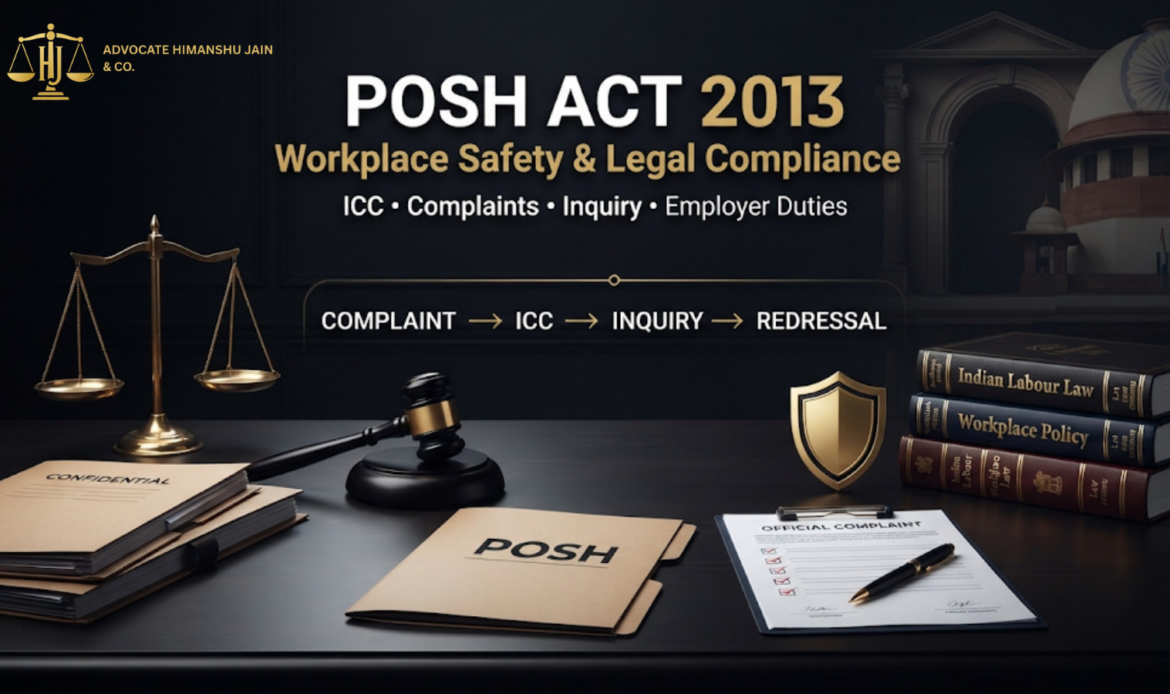
Table of Contents
What is the POSH Act?
The POSH Act is an Indian law passed by the Parliament in 2013 to protect women from sexual harassment at their place of work. It was formulated following the landmark Vishaka Guidelines laid down by the Supreme Court of India in the 1997 case Vishaka & Others v. State of Rajasthan — a case that arose from the brutal gang rape of a social worker in Rajasthan, which exposed the absence of any specific law addressing workplace sexual harassment in India.
Before the POSH Act, the Vishaka Guidelines served as the only legal framework for handling such complaints. The Act gave these guidelines statutory backing, making workplace safety a legally enforceable right rather than just a judicial recommendation.
READ MORE : DGGI and GST Bail: The Complete Guide to Hiring a GST Bail Lawyer in Delhi
Objectives of the POSH Act
The core objectives of the Prevention of Sexual Harassment Act are to:
- Provide a safe, secure, and harassment-free working environment for women
- Define what constitutes sexual harassment at the workplace
- Establish a redressal mechanism for complaints
- Mandate the formation of an Internal Complaints Committee (ICC) in every organization
- Ensure accountability of employers in preventing and addressing harassment
- Prescribe penalties for non-compliance
Who Does the POSH Act Apply To?
One of the most searched questions around POSH Act compliance is its scope of applicability. The Act applies to:
- All government and private organizations, NGOs, and unorganized sectors
- Companies with 10 or more employees (mandatory to constitute an ICC)
- Organizations with fewer than 10 employees (must have access to a Local Complaints Committee, or LCC)
- Educational institutions, hospitals, sports institutes, and stadiums
- Domestic workers (covered under the Act as well)
It’s important to note that the Act protects women employees — whether employed on a regular, temporary, ad hoc, or daily wage basis — including interns, contract workers, probationers, and apprentices, regardless of their designation.
What Constitutes Sexual Harassment Under the Act?
Under Section 2(n) of the POSH Act, sexual harassment includes any one or more of the following unwelcome acts or behavior:
- Physical contact or advances
- A demand or request for sexual favors
- Making sexually colored remarks
- Showing pornography
- Any other unwelcome physical, verbal, or non-verbal conduct of a sexual nature
The law also recognizes certain implied or explicit circumstances, such as promises of preferential treatment, threats of detrimental treatment, or creating a hostile work environment, as aggravating factors in a harassment complaint.
Internal Complaints Committee (ICC): Structure and Role
A key pillar of POSH Act compliance is the mandatory formation of an Internal Complaints Committee (ICC) in every workplace with 10 or more employees. The ICC must be headed by a senior woman employee and comprise:
- A Presiding Officer – a woman employed at a senior level
- Two members from among employees — preferably committed to women’s causes or with legal/social work experience
- One external member — from an NGO or association committed to the cause of women, or someone familiar with issues of sexual harassment
At least half of the total members of the ICC must be women. The involvement of an external member is designed to bring objectivity and prevent internal bias while handling sensitive complaints.
The Complaint and Redressal Process
The POSH Act complaint procedure is structured to ensure a fair, time-bound, and confidential resolution:
- Filing a complaint – The aggrieved woman can file a written complaint within 3 months of the incident (extendable by another 3 months if justified).
- Conciliation (optional) – Before initiating an inquiry, the ICC may, at the complainant’s request, attempt conciliation (without any monetary settlement).
- Inquiry – If conciliation fails or isn’t opted for, the ICC conducts an inquiry, giving both parties a fair opportunity to be heard.
- Timeline – The inquiry must be completed within 90 days.
- Recommendation & Action – Based on findings, the ICC recommends action to the employer, who must act within 60 days.
- Appeal – Either party can appeal the decision within 90 days of the recommendation.
Confidentiality is legally mandated throughout the process — details of the complaint, inquiry, and recommendations cannot be disclosed to the public or media.
Employer’s Duties Under the POSH Act
Employers carry significant legal responsibility under this law. Key employer obligations under POSH Act include:
- Constituting an Internal Complaints Committee at every branch/office
- Displaying the penal consequences of sexual harassment prominently at the workplace
- Organizing regular POSH awareness training and workshops
- Providing a safe working environment, including safe transportation where necessary
- Assisting the woman if she chooses to file a police complaint
- Monitoring timely submission of ICC reports
- Including sexual harassment-related information in the organization’s annual report
Penalties for Non-Compliance
Non-compliance with the POSH Act can prove costly for organizations. Penalties include:
- A fine of up to ₹50,000 for failing to constitute an ICC or comply with the Act’s provisions
- Cancellation or non-renewal of business licenses/registrations for repeated violations
- Higher fines and potential legal consequences for repeated offenses
Beyond financial penalties, non-compliance can severely damage an organization’s reputation, employee trust, and ability to attract and retain talent.
Why POSH Compliance Matters for Businesses
Beyond legal obligation, POSH Act compliance offers real business value:
- Builds trust – Employees feel safer and more valued
- Enhances employer brand – Increasingly a factor in talent acquisition
- Reduces attrition – A safe workplace improves retention
- Avoids litigation risk – Proactive compliance reduces legal exposure
- Improves productivity – A harassment-free environment fosters better collaboration
Many corporates now integrate POSH training programs, e-learning modules, and periodic ICC audits into their HR compliance calendars to stay ahead of regulatory requirements.
How to Ensure POSH Act Compliance in Your Organization
- Form and register your ICC with the appropriate authorities
- Draft and circulate a clear POSH policy
- Conduct regular sensitization training for employees and ICC members
- Maintain proper documentation of complaints and inquiries
- Include POSH disclosures in your annual compliance report
- Periodically review and update your POSH policy in line with amendments
Conclusion
The POSH Act 2013 remains one of the most significant legal safeguards for women in the Indian workforce. It goes beyond a compliance checkbox — establishing a culture of respect, accountability, and safety at the workplace. For organizations, staying compliant isn’t optional; it’s a legal necessity and a reflection of ethical business practice. For employees, understanding the Act empowers them to recognize their rights and seek redressal when needed.
Whether you’re building your company’s HR policies or simply want to understand your rights as an employee, staying informed about the POSH Act is the first step toward a safer, more inclusive workplace.
READ MORE: PoSH (Prevention of Sexual Harassment) in India – Complete Guide