
Category: Bail Matters

Can Bail Be Cancelled? Legal Grounds Explained

Getting can bail be cancelled feels like the end of a legal battle — but it isn’t always final. Many people are surprised to learn that a court can take back bail it has already granted. So can bail actually be cancelled, and if so, on what grounds? The short answer: yes. Indian law gives courts the power to cancel bail even after it has been granted, but only in specific, well-defined situations. This article breaks down exactly when bail can be revoked, who can ask for it, and what the process looks like. Note: This article is for general informational purposes and does not constitute legal advice. If you are dealing with a bail cancellation matter, consult a practicing criminal lawyer. What Does “Cancellation of Bail” Mean? Bail cancellation grounds is different from bail being refused in the first place. When a court refuses bail, it simply declines to release the accused. Cancellation, on the other hand, means the court takes back a bail order that was already in effect and sends the accused back into custody. Because bail cancellation grounds takes away liberty that has already been granted, courts treat it far more cautiously than an initial bail decision. The Supreme Court has repeatedly held that cancelling bail requires “cogent and overwhelming” circumstances — a much higher bar than simply having a strong case against the accused. The Legal Provision: Section 483 BNSS (Formerly Section 439 CrPC) With the Bharatiya Nagarik Suraksha Sanhita, 2023 (BNSS) replacing the Code of Criminal Procedure (CrPC) from 1 July 2024, the law on bail cancellation has been carried forward with the same underlying principles, just renumbered. Under these provisions, the High Court or Court of Session has the power to direct that a person released on bail be arrested again and taken into custody. Trial courts and Magistrates also retain related powers where the original bail order came from a lower court, and recent Supreme Court rulings have clarified that even trial courts can, in certain situations, act on violations of bail conditions imposed by a higher court. Importantly, the statute itself does not list out specific grounds in detail — those grounds have been built up over decades through Supreme Court and High Court judgments. READ MORE Regular Bail in Criminal and Cyber Cases: Complete Guide, Process & Recent Updates (2026) Legal Grounds on Which Bail Can Be Cancelled Courts have consistently identified a set of recurring situations that justify cancelling bail. Broadly, these fall under three themes: misuse of liberty, interference with the trial, and attempts to evade justice. 1. Violation of Bail Conditions Every bail order comes with conditions — not leaving the jurisdiction, appearing before the investigating officer, not contacting witnesses, surrendering a passport, and so on. Breaching any of these conditions is one of the most common and straightforward grounds for cancellation. 2. Tampering With Evidence If the accused is found destroying, altering, or manipulating evidence — physical or digital — this directly undermines the fairness of the trial and is a strong ground for revoking bail. 3. Threatening or Influencing Witnesses Courts take witness intimidation extremely seriously. Approaching, pressuring, or attempting to turn prosecution witnesses hostile is treated as a direct attack on the justice process and regularly results in bail being cancelled. 4. Interfering With the Investigation Any conduct that obstructs the police or investigating agency from doing their job — misleading them, hiding facts, or actively hampering their work — can lead to cancellation. 5. Committing a Fresh Offence While on Bail If the accused commits a new crime, or repeats similar conduct, while already out on bail, courts view this as a clear misuse of the liberty they were granted. 6. Absconding or Attempting to Flee Failing to appear for hearings, going underground, or trying to leave the country to escape trial is a classic and long-recognised ground for cancellation. 7. Bail Obtained Through Fraud or Misrepresentation If it later comes to light that the accused secured bail by concealing facts, submitting false information, or misrepresenting circumstances to the court, the bail order itself can be set aside. 8. Supervening Circumstances Sometimes new facts emerge after bail is granted — for instance, evidence showing the accused is far more dangerous or influential than initially understood — that change the balance the court originally struck. Courts can revisit bail in light of such developments. The Supreme Court’s landmark ruling in Gurcharan Singh v. State (Delhi Administration) remains a guiding precedent, holding that there is no fixed formula for cancellation — each case turns on its own facts, weighed against the risk of the accused fleeing or tampering with the prosecution’s case. Who Can Apply for Cancellation of Bail? A bail cancellation grounds application isn’t limited to the prosecution. It can be filed by: How the Bail Cancellation Process Works Courts are conscious that cancelling bail is a serious step affecting a person’s freedom, so they generally require solid, verifiable evidence rather than allegations alone. Bail Cancellation vs. Bail Rejection: Key Difference Aspect Bail Rejection Bail Cancellation Stage Before bail is granted After bail has already been granted Standard Court assesses risk factors at first instance Requires strong, overwhelming grounds Effect on accused Remains in custody Was free, now sent back to custody Common trigger Nature of offence, flight risk, evidence tampering risk Actual conduct after release (violation, threats, new offence) FAQs on Bail Cancellation 1. Can bail be cancelled without any violation of conditions? Generally, no. Courts require concrete grounds such as tampering with evidence, threatening witnesses, absconding, or committing a fresh offence. Cancellation is not granted merely because the case is serious or the prosecution is dissatisfied with the original bail order. 2. Who has the power to cancel bail in India? Under Section 483(3) BNSS (formerly Section 439(2) CrPC), the High Court and Court of Session have the power to cancel bail. Recent Supreme Court rulings have also clarified that trial courts can act to cancel bail where conditions imposed by..

Regular Bail in Criminal and Cyber Cases: Complete Guide, Process & Recent Updates (2026)

Getting arrested is one of the most disorienting experiences a person can go through, and one of the first questions that comes up — for the accused and their family — is simple: how do we get out? The answer, in most cases, is regular bail in criminal cases . This guide walks through what regular bail means, how the regular bail process works in ordinary criminal cases, how it applies to cyber crime bail cases, and the latest Supreme Court and High Court updates shaping bail law in India in 2026. A quick note before we start: this is general legal information, not legal advice. Bail outcomes depend heavily on the specific facts of a case, the court, and the judge, so anyone facing an actual arrest should consult a criminal lawyer directly. What Is Regular Bail in criminal cases? Meaning and Legal Definition Regular bail in criminal cases is the release of a person who has already been arrested and is sitting in police or judicial custody, granted while the investigation or trial is still going on. It’s different from two other kinds of bail people often confuse it with: Regular bail in criminal cases, by contrast, is a post-arrest remedy. The person is already in custody, and the application asks the court to let them out on conditions — usually a bond, sometimes with sureties — while the case proceeds. Regular Bail in Criminal Cases Under BNSS 2023: Section 483 BNSS Explained (Replacing Section 439 CrPC) If you’ve read anything about regular bail in criminal cases in Indian newspapers or old textbooks, you’ve probably seen references to “Section 439 CrPC” or “Section 437 CrPC.” Those provisions no longer exist. On 1 July 2024, the Code of Criminal Procedure, 1973 was replaced by the Bharatiya Nagarik Suraksha Sanhita (BNSS), 2023, and the bail provisions were renumbered along with it. Old CrPC Section Subject New BNSS Section 436 Regular Bail in criminal cases bailable offences (matter of right) 478 436A Release of undertrials who’ve served a set portion of their sentence 479 437 Regular Bail in criminal cases non-bailable offences (Magistrate’s power) 480 438 Anticipatory bail 482 439 Special powers of the High Court/Sessions Court to grant bail 483 167 Default bail on non-filing of chargesheet 187 The underlying philosophy hasn’t changed — Indian courts have long held that “bail is the rule, jail is the exception,” a principle that traces back to landmark judgments emphasizing personal liberty under Article 21 of the Constitution. What’s changed is the numbering, and a few procedural tweaks around remand periods, video-recorded arrests, and undertrial release timelines. Read more- Dowry Death in India: Section 304B IPC, BNS Section 80, Case Laws & Legal Guide Bailable vs. Non-Bailable Offences: How the Regular Bail in Criminal Cases Process Differs This distinction shapes the entire bail process. Bailable offences — generally less serious ones — give the accused an almost automatic right to bail under Section 478 BNSS. The police or the magistrate simply have to accept a bond, with or without sureties. There’s very little judicial discretion involved. Non-bailable offences — more serious crimes — don’t come with that automatic right. Here, bail is granted or refused based on judicial discretion under Section 480 BNSS (before a Magistrate) or Section 483 BNSS (before the Sessions Court or High Court). Courts weigh several factors before deciding: Ordinarily, an application for non-bailable offences goes first to the Magistrate’s court. If refused there, the next step is the Sessions Court, and only after that, if needed, the High Court — courts have generally discouraged skipping the Sessions Court and going straight to the High Court, though the two technically share concurrent jurisdiction. Regular Bail in Cyber Cases: How to Get Bail in Cyber Fraud Cases Cyber offences bring their own layer of complexity, largely because they sit at the intersection of two different laws: the Information Technology Act, 2000 and general criminal law (now the Bharatiya Nyaya Sanhita, 2023, which replaced the IPC). A few things that typically matter more in cyber bail applications: 1. Mixed charges are common. Someone accused of online fraud, for example, might face charges both under IT Act provisions (like Section 66 for computer-related offences, or 66C/66D for identity theft and cheating by personation) and under BNS provisions for cheating, criminal breach of trust, or extortion. The regular bail in criminal cases analysis has to account for all the charges together, and the most serious one usually drives the strategy. 2. Digital evidence changes the “tampering” argument. In a physical crime, the concern is often about the accused intimidating witnesses or destroying physical evidence. In cyber cases, the worry is different — deleting server logs, wiping devices, destroying digital trails, or using VPNs and anonymization tools to keep offending. Prosecutors often argue this makes cyber-accused persons a higher flight or tampering risk; defense lawyers, in turn, argue that once devices are already seized and forensically imaged, that risk disappears. 3. Electronic evidence certification matters. Under the Bharatiya Sakshya Adhiniyan (which replaced the Evidence Act), electronic records need a proper certificate (broadly under what was Section 65B, now recodified) to be admissible. A bail application can sometimes highlight procedural gaps — for instance, if devices weren’t seized with proper documentation, or if there’s no certified digital evidence linking the accused to the offence — as a ground for release. 4. Jurisdiction and multiple FIRs. Cyber offences frequently span states — a victim in one city, a server in another, an accused in a third. This sometimes leads to multiple FIRs for connected transactions, which courts have increasingly clubbed together, and bail applications often need to address all connected FIRs together to avoid re-arrest. 5. Bailable in many cases. It’s worth noting that a good number of IT Act offences are actually bailable by classification (particularly first-time, lower-value offences), meaning the automatic right under Section 478 BNSS applies. It’s the higher-value fraud cases, especially those charged jointly with BNS provisions for cheating or criminal..

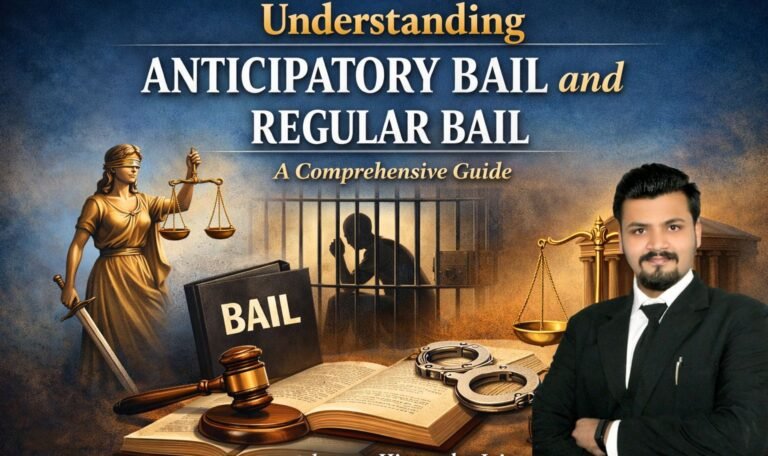
Anticipatory Bail and Regular Bail – Get a complete knowledge

Anticipatory bail and regular bail are legal provisions available to individuals facing possible arrest or criminal accusations. Knowing your options can make all the difference. Although both are intended to safeguard a same common personal freedom, they are dissimilar in terms of implementation, time and law. What is Regular Bail? Ordinary bail or simply ‘Regular’ bail Under the criminal procedure law (CrPC) an offender who is arrested and in custody of police has got a legal right to secure a temporary freedom, known as regular Bail. This is specified in Sections 436 to 450 of the CrPC. When can Regular bail be given? Ordinary bail can be applied in the below cases: For Non-Bailable Offenses: Bail is the right of accused as per Section 436 of the CrPC, in such crimes which are punishable with less than three years punishment of by nature a bailable offense. The accused should be released upon furnishing a bond with or without sureties. For Non-Bailable Offense : According to Section 437 of the CrPC, bail for non-bailable offense is a matter of discretion. The court takes in to account the nature and seriousness of the offense, strength of evidence, special circumstances relating to the accused and probability that he will abscond. Conditions for Granting Regular Bail Regular bail is usually granted by courts considering a few factors: The charge against the accused is also of importance. Courts consider whether there is reasonable cause to hold that the suspect has committed a non bailable offense, but does not need the certainty of being guilty as in the case of conviction. The nature, circumstances, extent of the offence and other factors assessing flight risk are considered. The previous criminal record, if any, is taken into account to see the probability of recidivism. The courts will also consider if the accused represents any danger to the witnesses or investigation. The danger of tampering with evidence or potential witness interference is a significant factor. What is Anticipatory Bail? Bail in anticipation of arrest or anticipatory bail is a distinct provision in the bail mechanism under Section 438 of the CrPC, by which a person can seek bail even before he is taken to custody. The text of this provision is premised upon the understanding that arrest independent of prosecution may be humiliating,4and traumatizing, and affords safeguards to those believing that they might be falsely implicated or wrongfully arrested. Legal Framework of Anticipatory Bail Under section 438 of the CrPC (Code of Criminal Procedure), a person has to satisfy the Sessions Court or High Court that they may be arrested in a non-bailable offense and that there are reasons which do not constitute sufficient grounds for arrest. This section embodies the principle that personal liberty is valuable and is to be safeguarded against arbitrary arrest. In When You Should File for AB? Applications of anticipatory bail is advisable under 2 situations: You have reliable information or you reasonably suspect that you are being arrested in a non-bailable offense. This may be due to complaints that are in the pipeline, investigations that have begun or threats of hearsay allegation. There are a lot of cases in which allegations are so absurd, and contrary to the facts; surprisingly such type of complaints are filed against innocent persons for vindicating such nefarious intent of accused involved in matrimonial disputes, family property/ business dispute wherein blackmailing by filing criminal Complaints takes place. You are likely to get arrested out of political vendetta, competition in business or due to personal rivalry when misuse of law also is seen as harassment. Conditions Imposed with Anticipatory Bail While granting AB, courts generally put in several conditions to ensure proper conduct of investigation and trial: The applicant shall co-operate with the investigation and he shall make himself available for interrogation whenever the investigating officer requires him to do so. Accused are directed by the courts to join investigation on fixed dates and timings. The defendant can be ordered not to leave the country without the court’s permission, and might also have to surrender their passport. A common term is that the accused must not threaten, harass, or communicate with witnesses and evidence tampering is also prohibited. Courts can also put conditions stipulating accused to visit police station at regular intervals or provide contact information, including address residency and mobile number. Differences Between the Regular Bail and Anticipatory Bail Timing of Application But the most basic distinction is about timing. Normal bail is applied after the individual has been arrested and in custody, while anticipatory bail is sought prior to arrest with the expectation that they may be detained. Jurisdiction and Authority Normal bail applications can be made in the Magistrate, the Sessions or High Court depending upon the stage of a case. Anticipatory bail may only be granted by Sessions Court or HC under Section 438 of CrPC. Nature of Protection Bail is regular release from the actual custody and not arrest. When an anticipatory bail is allowed, the person cannot be held beyond a particular period as provided in the order and if arrested, he must be released on bail. Burden of Proof In standard bail cases, a defendant bears the burden to show that they should be released from jail. In anticipatory bail, an applicant must show that he has some kinds of ”facial reasons” to panicking for his arrest and it may be groundless or motivated. Duration and Continuity Bail required under the General Rule remains in force until the end of the trial unless it is surrendered or changed. The anticipatory bail will be for a period of time or until the investigation, trial or appeal is over as the case may be. Grounds for Seeking Anticipatory Bail Anticipatory Bail Several situations arise where one should apply for anticipatory bail: Important Supreme Court Judgments There are some leading judgments that have developed law with respect to bail in India : In Sushila Aggarwal v. State (NCT of Delhi) (2020), the Supreme Court held that there can be no restriction with regard to time for an order directing anticipatory bail and it may continue till the chargesheet is filed, ensuring full protection to the accused during trial. The Arnesh Kumar v. State of Bihar (2014) was a historic judgment that..

To Top