
Category: Blog

Bail Advocate in High Court: Complete Guide to Getting Bail Fast and Legally

Introduction Getting arrested — or fearing arrest — is one of the most stressful experiences a person or their family can go through. In such moments, the first and most important step is finding an experienced bail advocate in High Court who understands the procedure, timelines, and legal nuances of securing bail quickly. Whether you need anticipatory bail before an arrest or regular bail after being taken into custody, a skilled High Court bail lawyer can be the difference between days in custody and a swift release. This blog covers everything you need to know about hiring a bail advocate, the bail process in High Courts, and answers to the most commonly searched questions on this topic. Who is a Bail Advocate? A bail advocate is a criminal lawyer who specializes in filing and arguing bail applications before Sessions Courts, High Courts, and even the Supreme Court. Their core job is to: A High Court bail advocate specifically handles matters that have moved beyond the Sessions Court — either because the lower court rejected bail, or because the case involves serious offences that require High Court intervention. READ MORE AT How to Defreeze Bank Account and Remove Lien Mark from PAN in India (2026 Guide) Why You Need a High Court Bail Lawyer Many people wonder why a High Court advocate is needed when a local lawyer could help at the Sessions Court level. Here’s why High Court representation matters: 1. Complex and Serious Charges Cases involving offences under stringent laws (economic offences, NDPS Act, UAPA, POCSO, etc.) often require a specialized High Court bail advocate who understands nuanced case law and precedent. 2. Sessions Court Bail Rejection If a Sessions Court has already rejected a bail plea, the next step is moving to the High Court — this requires a lawyer experienced in High Court procedure and drafting. 3. Faster, Precedent-Based Arguments High Court advocates are usually well-versed in recent judgments and Supreme Court precedents that strengthen a bail plea. 4. Anticipatory Bail Applications Types of Bail Handled by High Court Advocates Type of Bail When It Applies Regular Bail After arrest, when a person is already in custody Anticipatory Bail Before arrest, when there is apprehension of arrest Interim Bail Temporary bail granted while the main application is pending Default Bail When the police fail to file a chargesheet within the statutory period Bail Cancellation Matters When the prosecution seeks to cancel bail already granted Step-by-Step Bail Application Process in High Court Qualities to Look for in a Bail Advocate Common Mistakes to Avoid When Seeking Bail Conclusion Navigating the bail process can feel overwhelming, especially when time is critical and emotions run high. Engaging an experienced bail advocate in High Court ensures that your case is presented effectively, procedural requirements are met, and the chances of a favorable and swift bail order are maximized. If you or a loved one is facing arrest or seeking bail, consult a qualified High Court bail lawyer promptly — timely legal action often makes all the difference. READ MORE http://Complete Guide to Bail in High Court: Anticipatory, Regular & Interim Bail (2026)

How to Defreeze Bank Account and Remove Lien Mark from PAN in India (2026 Guide)

If your bank account has suddenly stopped working, or you’ve discovered a lien mark on your PAN, you’re not alone — this is one of the most searched banking issues in India today. Whether it’s an income tax attachment, a court order, or a KYC lapse, this guide explains exactly how to defreeze bank account in india and get the lien removed from your PAN across every bank you hold accounts with. Why Was My Bank Account Frozen? (Common Causes) how to defreeze bank account in India almost always traces back to one of these: What Does “Lien Mark on PAN Pan-India” Actually Mean? Because Indian banks use PAN as the common identifier for account holders, a lien or freeze order issued against your PAN can surface across multiple banks nationwide — not just the branch where the order originated. This is why people search specifically for how to defreeze bank account in india a lien mark from PAN pan-India, rather than just “unfreeze my account” — the goal is to clear the order at its source so it stops affecting every linked account. READ MORE AT https://advocatehimanshujain.com/lawyer-for-consumer-disputes-in-delhi/ Step-by-Step: How to Defreeze a Bank Account in India Step 1: Find Out Why the Account Was Frozen Check your net banking remarks or visit your branch and formally request the reason in writing. Step 2: Get a Copy of the Freeze/Attachment Order This document identifies the issuing authority — Income Tax, court, GST, or EPFO — and is required for every next step. Step 3: Resolve the Issue With the Issuing Authority (Not the Bank) Banks only execute freeze orders — they can’t lift them independently. Step 4: Get the Official Release Order Once resolved, the authority issues a withdrawal/release letter — the only document that can actually lift the freeze. Step 5: Submit the Release Order to Your Bank(s) Share it with your primary bank and any other banks where the lien may have been PAN-linked. Step 6: Confirm the Lien Is Cleared Everywhere Follow up with each bank to confirm the PAN-linked lien is removed system-wide, not just at one branch. Step 7: Update KYC if That Was the Root Cause If it was a KYC-related freeze, simply submitting updated documents resolves it — no external authority needed. How Long Does It Take to Unfreeze a Bank Account? How to Avoid a Frozen Account or PAN Lien in the Future Conclusion How to defreeze bank account in india or a lien mark on your PAN can feel like a financial emergency, but it’s rarely permanent. The key is identifying the exact source of the freeze — income tax, court, GST, EPFO, or a simple KYC lapse — and resolving it directly with that authority, since the bank itself is only carrying out the order. Once you have the official release letter in hand, clearing the lien across every bank linked to your PAN is usually just a matter of submitting that document and following up. The bigger takeaway: how to defreeze bank account in india most freezes are preventable. Staying current on KYC, responding promptly to tax and GST notices, and periodically checking your compliance status on the income tax e-filing portal will save you from ever having to go through this process at all. If you’re dealing with an active freeze right now, don’t wait — the sooner you engage with the issuing authority, the sooner your account (and your PAN) is clear again. How to Unfreeze a Bank Account in India: Causes, Steps & Timeline (2026)

Lawyer for Consumer Disputes in Delhi

Introduction: Why You Need a Lawyer for Consumer Disputes in Delhi In today’s fast-paced marketplace, lawyer for consumers disputes in Delhi frequently face issues like defective products, deficient services, unfair trade practices, and outright fraud by sellers or service providers. If you have been cheated by a company, builder, e-commerce platform, insurance provider, or any service provider in Delhi, you have the legal right to seek justice under the Consumer Protection Act, 2019. Hiring a skilled lawyer for consumer disputes in Delhi ensures that your complaint is drafted correctly, filed in the right forum, and argued effectively — saving you time, money, and unnecessary stress. Whether your case involves a District lawyer for Consumer Disputes in Delhi Redressal Commission (DCDRC), State Commission, or the National Consumer Disputes Redressal Commission (NCDRC), professional legal representation can make all the difference between winning and losing your claim. This blog covers everything you need to know about consumer dispute cases in Delhi, how the process works, and why choosing the right consumer court advocate matters. What Is a Consumer Dispute? A consumer dispute arises when there is a disagreement between a consumer and a seller, manufacturer, or service provider regarding: Common Types of Consumer Dispute Cases in Delhi 1. Real Estate and Builder Disputes Delhi-NCR has seen a surge in cases where homebuyers face delayed possession, poor construction, or non-refund of booking amounts. A consumer lawyer can help file complaints against builders under RERA and the Consumer Protection Act simultaneously. 2. E-commerce and Online Shopping Complaints With online shopping on the rise, disputes over counterfeit products, non-delivery, and refund denials are increasingly common in Delhi’s consumer courts. 3. Medical Negligence Cases Patients who suffer due to negligent treatment by hospitals or doctors can file a consumer complaint seeking compensation for medical negligence. 4. Banking, Loan, and Insurance Disputes Wrongful loan foreclosure charges, mis-sold insurance policies, and unjust claim rejections are frequent grounds for consumer litigation. 5. Defective Product Complaints Electronics, vehicles, home appliances, and other goods that malfunction or fail to meet promised standards often lead to consumer forum cases. READ MORE Can Bail Be Cancelled? Legal Grounds Explained Step-by-Step Process to File a Consumer Complaint in Delhi Why Hire an Experienced Consumer Court Advocate in Delhi? A knowledgeable advocate not only strengthens your case but also helps you avoid common mistakes like filing in the wrong jurisdiction, missing limitation periods, or submitting incomplete documentation. Documents Required to File a Consumer Case Time Limit for Filing a Consumer Complaint Under the Consumer Protection Act, a complaint must generally be filed within two years from the date the cause of action arose. However, delays can sometimes be condoned if sufficient cause is shown — your lawyer can advise on this based on your specific case facts. How Much Compensation Can You Claim? Compensation in consumer cases may include: The final amount depends on the facts of the case, evidence presented, and arguments made by your consumer dispute lawyer. Conclusion Consumer rights are powerful legal tools, but navigating the Consumer Protection Act and forum procedures without professional guidance can be challenging. If you are dealing with a defective product, service deficiency, builder dispute, or fraud, consulting an experienced lawyer for consumer disputes in Delhi is the smartest step toward getting justice and fair compensation. A well-prepared complaint, backed by the right legal strategy, significantly increases your chances of a favorable outcome — whether through the District Commission, State Commission, or NCDRC. How to File Consumer Complaint in Delhi

Dowry Death in India: Section 304B IPC, BNS Section 80, Case Laws & Legal Guide

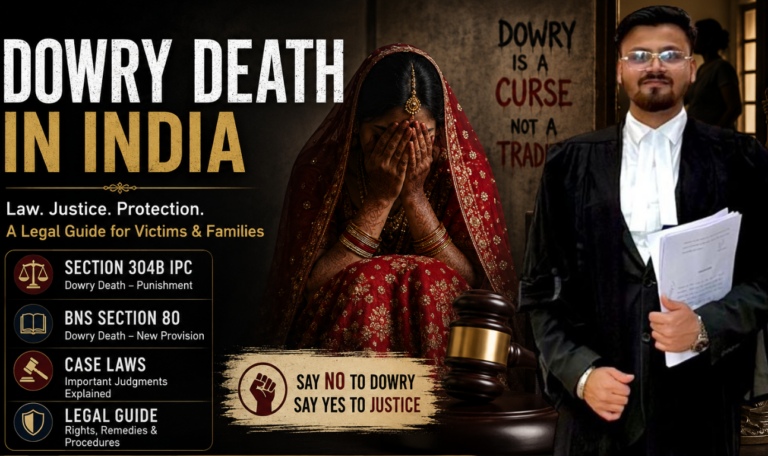
Published on advocatehimanshujain.com  |  Criminal Law  |  Family Law  |  May 2025 Every few hours, a woman, because of her husband’s family was not satisfied with what she brought to the marriage faces dowry death in India. The National Crime Records Bureau reported over 6,450 dowry deaths in 2022 alone. That is roughly 17 women every single day. These are not accidents. They are crimes. And yet, many families — both victims’ and accused — walk into these situations without understanding what the law actually says, what investigators look for, and what courts have consistently held. This article breaks it all down: the law under both the old Indian Penal Code and the new Bharatiya Nyaya Sanhita, the evidence standard courts apply, real case outcomes, and what you should — and absolutely should not — do if you find yourself caught in these circumstances. What Is Dowry Death in India? The Legal Definition Before going into the sections, let’s be clear about what dowry itself means under law. The Dowry Prohibition Act, 1961 defines dowry as any property or valuable security given or agreed to be given, directly or indirectly, by one party to a marriage to the other — in connection with the marriage. Gifts given out of love, without any condition attached, generally fall outside this definition. But ‘gifts’ that were effectively demanded — even if dressed up as voluntary — do not. Dowry death, in legal terms, occurs when a woman dies within seven years of marriage under circumstances that suggest burns, bodily injury, or otherwise unnatural causes, and there is evidence that she was subjected to cruelty or harassment in connection with dowry demands before her death. The Law: IPC Section 304B and BNS Section 80 Under the Indian Penal Code — Section 304B IPC Section 304B IPC was inserted in 1986 specifically to address the epidemic of young married women dying in suspicious circumstances. To read the full text of the provision, see the Indian Kanoon entry for Section 304B IPC. Section 304B IPC — The Statutory Text Where the death of a woman is caused by any burns or bodily injury or occurs otherwise than under normal circumstances within seven years of marriage, and it is shown that soon before her death she was subjected to cruelty or harassment by her husband or any relative of her husband for, or in connection with, any demand for dowry, such death shall be called ‘dowry death’ and such husband or relative shall be deemed to have caused her death. Punishment: Minimum 7 years imprisonment, extendable to life. Under the Bharatiya Nyaya Sanhita (2023) — Section 80 BNS The BNS replaced the IPC with effect from July 1, 2024. Section 80 BNS replicates the substance of Section 304B IPC with the same essential ingredients and the same punishment range. Cases registered before July 1, 2024 continue under the IPC. All new cases use the BNS. Provision (IPC) Equivalent Provision (BNS) Section 304B — Dowry Death Section 80 — Dowry Death Section 498A — Cruelty to wife Section 85 — Cruelty to wife Section 306 — Abetment of Suicide Section 108 — Abetment of Suicide Section 302 — Murder Section 103 — Murder Section 113B Evidence Act (Presumption) Section 118 BSA (Presumption) The Essential Ingredients Courts Look For For a conviction under Section 304B IPC / Section 80 BNS, the prosecution must prove four things: 1. Death Within Seven Years of Marriage The clock starts from the date of marriage, not the date dowry demands began. If the death occurs even one day after seven years, Section 304B does not apply — though other provisions may. For a deeper understanding of how courts have interpreted this threshold, see our related article on Section 498A and marital cruelty. 2. Death by Burns, Bodily Injury, or Otherwise Unnatural Circumstances Natural deaths from illness, unless connected to dowry cruelty, do not qualify. Courts have accepted poisoning, strangulation, hanging, and forced falls as ‘unnatural circumstances.’ The Supreme Court of India has repeatedly held that forensic evidence on the nature of death is critical. 3. Cruelty or Harassment in Connection with Dowry Demands This is where most contested cases are fought. The harassment must be linked to dowry — not to other marital disputes. Courts have held consistently that general marital unhappiness does not qualify. For cases involving domestic violence alongside dowry harassment, the Protection of Women from Domestic Violence Act, 2005 provides parallel civil remedies. 4. The Harassment Must Be ‘Soon Before Her Death’ This phrase has been interpreted differently by different High Courts. The Supreme Court settled in Kans Raj v. State of Punjab (2000) that ‘soon before’ does not mean immediately before — it means within a reasonable time, judged case by case. Gaps of weeks or even a couple of months have been accepted where the pattern of harassment was continuous. The Presumption Clause: Why This Changes Everything Section 304B contains a built-in legal presumption under Section 113B of the Indian Evidence Act (now Section 118 of the Bharatiya Sakshya Adhiniyam, 2023): The Mandatory Presumption Once the prosecution establishes that the death was unnatural and occurred within seven years of marriage, and that there was harassment connected to dowry, the court presumes that the husband or his relatives caused the death. This reverses the usual burden of proof. The accused cannot simply wait for the prosecution to fail — they must actively rebut the presumption with concrete evidence. In Baijnath v. State of Madhya Pradesh (2017), the Supreme Court reiterated that this is a mandatory presumption — once the foundational facts are proved, the court has no discretion but to presume guilt. Silence or a mere denial is not a defence. Section 498A IPC / Section 85 BNS: The Cruelty Provision Section 304B rarely operates alone. It is almost always read with Section 498A IPC (now Section 85 BNS), which deals with cruelty to married women by husbands and their relatives. For a detailed breakdown of how 498A..

White Collar Crime Lawyer in Delhi | Expert Defence — Advocate Himanshu Jain

1. What Exactly Is a White Collar Crime? The phrase ‘white collar crime’ was coined in 1939 by sociologist Edwin Sutherland to describe offences committed by people of respectability and high social status in the course of their occupation. In plain terms: fraud, bribery, embezzlement, money laundering — crimes of deception rather than violence. In India, courts and legislators have never drawn a single definition into one statute. Instead, white collar offences are spread across multiple laws — the Indian Penal Code, the Prevention of Corruption Act, the Companies Act, the Income Tax Act, and more recently the Prevention of Money Laundering Act (PMLA). What ties them together is the method: misuse of trust, position, or information for financial gain. The scale of the problem is hard to ignore. CBI data routinely shows thousands of cases registered each year under bank fraud and corruption heads alone. The ED’s PMLA caseload has grown sharply since 2019, partly reflecting legislative changes that expanded the list of predicate offences. If you are a professional, a business owner, or a company director in India, understanding where the lines are drawn is not optional — it is necessary. 2. Common Types of White Collar Crimes in India 2.1 Bank Fraud and Financial Fraud Bank fraud covers a wide range of conduct: forged documents, inflated loan applications, fictitious accounts, and round-tripping of funds. The primary statute is Section 420 IPC (cheating) read with various RBI guidelines. Larger frauds — typically above Rs. 50 lakh — also attract provisions of the Banking Regulation Act, 1949 and attract CBI involvement. The Nirav Modi and Vijay Mallya cases became reference points for how aggressively Indian agencies now pursue large-scale bank fraud, including seeking extradition from foreign jurisdictions. 2.2 Corporate Fraud Fraud within or against companies is governed primarily by the Companies Act, 2013. Section 447 defines fraud as ‘any act, omission, concealment of any fact or abuse of position committed by any person… with intent to deceive.’ The Serious Fraud Investigation Office (SFIO) handles complex corporate fraud, and its reports go directly to the Ministry of Corporate Affairs. Directors and auditors are most exposed here. An auditor who knowingly certifies false accounts, or a director who approves fictitious transactions, faces personal criminal liability — not just civil penalties. 2.3 Money Laundering Money laundering involves disguising the origins of proceeds from criminal activity. In India, the Prevention of Money Laundering Act, 2002 (PMLA) gives the Enforcement Directorate sweeping powers: provisional attachment of property, summons, arrest without a magistrate’s order in certain cases, and a reversed burden of proof at trial — once the ED establishes a prima facie case, the accused must prove innocence. That reversed burden is the aspect most accused persons fail to appreciate until it is too late. It is also the reason why engaging a lawyer from the moment you receive a summons — not an FIR — is the practical standard of care. 2.4 Tax Evasion Under the Income Tax Act, 1961, wilful evasion of tax is a criminal offence carrying imprisonment of up to seven years. ‘Wilful’ is doing real work here — the prosecution must prove intent, not mere negligence. That said, the Income Tax department has the power to conduct searches, seizures, and surveys, and statements recorded during a search can be used as evidence in subsequent prosecution proceedings. 2.5 Bribery and Corruption The Prevention of Corruption Act, 1988 (as amended in 2018) makes both the giver and taker of a bribe criminally liable. The 2018 amendment was particularly significant: it brought private sector employees within its scope for certain offences and created a specific provision on commercial organisations failing to prevent bribery by associated persons. CBI has jurisdiction over central government employees. State Vigilance/Anti-Corruption Bureaux handle state-level matters. Lokpal now has authority to receive complaints against public servants of a certain grade. 2.6 Cyber Fraud and Online Financial Crimes Phishing, online investment scams, and identity theft all sit at the intersection of the Information Technology Act, 2000 and the IPC. As transactions moved online, so did fraud — and the legal framework is still catching up. Our firm handles cyber fraud matters in Delhi, including cases registered under Sections 66C and 66D IT Act. 2.7 Cheque Dishonour / Cheque Bounce Section 138 of the Negotiable Instruments Act is technically not categorised as a white collar crime in academic literature, but in practice it sits squarely in this space — it is fraud through a financial instrument. Millions of cases are pending across India. Our dedicated resource on cheque bounce cases in Delhi covers the procedural steps in detail. 3. Which Agencies Investigate White Collar Crimes in India? India has a layered, sometimes overlapping, investigative structure. Knowing which agency has seized a matter — and under which statute — determines your immediate legal exposure. Agency Primary Statute(s) Key Power CBI IPC, PC Act, Banking Laws Nationwide jurisdiction; high court oversight Enforcement Directorate (ED) PMLA, FEMA Asset attachment, reversed burden of proof SFIO Companies Act, 2013 Investigations into complex corporate fraud Income Tax Dept. Income Tax Act, 1961 Raids, surveys, prosecution complaint State Police / EOW IPC, State-specific Acts FIR registration, Economic Offences Wing We represent clients in CBI and ED matters before Delhi courts. You can read more about our CBI and ED case services here. 4. Penalties: What Are the Stakes? The range is wide. At one end, certain tax irregularities attract compounding — paying a sum to settle without prosecution. At the other end, PMLA conviction carries a minimum of three years’ imprisonment, extendable to seven, with rigorous imprisonment in cases involving Scheduled Offences related to narcotics. IPC Section 420 (cheating) carries up to seven years. SFIO prosecutions under the Companies Act can result in imprisonment up to ten years for aggravated fraud. Corruption cases carry a minimum sentence of three years under the amended PC Act. Courts also impose financial penalties, asset forfeiture, and — increasingly — travel restrictions through lookout notices and LOC (Look Out Circulars) even..

What is Anti-Corruption Bureau (ACB)? Roles, Powers & Functions Explained

By Advocate Himanshu Jain & Co. Corruption continues to be one of the most pressing legal and governance challenges in India. Through years of legal practice, it has become evident that institutions like the Anti-Corruption Bureau (ACB) play a decisive role in maintaining accountability within public systems. Working closely with investigative bodies such as the economic offences wing, the ACB ensures that misuse of authority and financial misconduct are brought under judicial scrutiny. Understanding ACB and the Role of EOW The Anti-Corruption Bureau primarily investigates offences involving bribery, abuse of official position, and disproportionate assets. Alongside this, the eow—whose eow full form is Economic Offences Wing—handles intricate financial crimes including fraud, forgery, and corporate irregularities. Clients often approach with queries like what is eow or how the eow department functions within eow india. In cities like Delhi, the economic offences wing delhi actively investigates high-profile eow cases, and individuals can formally register an eow complaint in matters involving financial fraud or corruption-linked offences. Roles and Powers of the Anti-Corruption Bureau From a legal standpoint, the ACB is empowered to: These powers are exercised with procedural precision, ensuring that investigations meet the evidentiary standards required in court. FIR in Corruption Cases & Legal Remedies In most corruption-related matters, proceedings begin with the registration of an FIR. However, not every FIR is legally sustainable. This is where the concept of quashing of fir becomes crucial. Many clients seek clarity on what is quashing of fir, especially in cases where allegations are exaggerated or legally untenable. Under the Bharatiya Nagarik Suraksha Sanhita, provisions such as section 528 bnss (also referred to as 528 bnss, sec 528 bnss, or bnss 528 section) grant the judiciary significant authority. The inherent powers of high court under bnss enable the court to intervene and prevent abuse of legal process. Through an application under section 528 bnss, an accused can request quashing of fir under bnss. Quashing of FIR: Legal Process Explained Understanding how to quash fir in high court requires strategic legal planning. The fir quashing procedure involves filing a petition supported by legal grounds and precedents. Courts typically examine valid grounds for quashing of fir, such as: If the court is satisfied, it may order quashing of fir in high court, effectively nullifying the case. The fir quashed meaning implies that the accused is discharged from further legal proceedings related to that FIR. Importance of Expert Legal Representation Handling matters involving ACB or EOW requires in-depth legal expertise. Whether it is responding to an investigation or seeking relief through quashing, professional guidance is indispensable. Engaging an experienced eow lawyer in delhi, criminal lawyer in delhi, or cyber crime lawyer in delhi ensures that your case is handled with precision. For complex digital or financial offences, consulting the best cyber crime lawyer in delhi or a seasoned advocate in delhi can make a substantial difference. At Advocate Himanshu Jain & Co., every case is approached with a strategic, detail-oriented mindset, ensuring clients receive comprehensive legal support. Choosing the right lawyer in delhi is not just about representation—it is about safeguarding your legal rights. Conclusion The Anti-Corruption Bureau remains a cornerstone in India’s fight against corruption. Working in coordination with the economic offences wing, it ensures that unlawful practices are investigated and prosecuted effectively. At the same time, legal provisions like section 528 of bnss provide essential safeguards against misuse of the law, reinforcing the principles of fairness and justice.

Anticipatory Bail vs Regular Bail vs Interim Bail: When You’re Facing Arrest — Which Bail Do You Actually Need?

Most people only learn what “anticipatory bail” means the day they need it. By that point, they’re panicking, their family is panicking, and the last thing they want is a lawyer explaining legal theory to them. So let’s skip the theory where we can. Here’s what the three types of bail actually mean, when each one applies, and what happens when you pick the wrong one — or wait too long. At Advocate Himanshu Jain & Company, we’ve handled hundreds of bail matters across Delhi’s courts. The cases below are drawn from the kinds of situations we see regularly. Names have been changed to protect client privacy. Anticipatory Bail — Before the Arrest Happens Anticipatory bail is protection you seek before you’re arrested. The name comes from Section 438 of the Code of Criminal Procedure — you’re anticipating an arrest and asking the court to step in before it happens. This is probably the most misunderstood of the three. A lot of people think you can only approach a court after something has happened to you. That’s not true. If you have credible reason to believe an arrest is coming — a summons, word that an FIR has been filed against you, a dispute that’s turned ugly — you can approach the Sessions Court or the High Court for pre-arrest protection. The court, when granting anticipatory bail, typically attaches conditions. Common ones include surrendering your passport, appearing at a police station on specified dates, not leaving the country without permission, and not contacting the complainant or witnesses. These aren’t optional suggestions — violating them gets the bail cancelled. The window is narrow. Once you’re arrested, Section 438 no longer applies. That option closes permanently. What the courts look at When deciding anticipatory bail, judges typically weigh: The Supreme Court has, over the years, made clear that anticipatory bail should not be withheld merely because the offence is serious. In Gurbaksh Singh Sibbia v. State of Punjab (1980), the Court held that the power under Section 438 should be exercised with due care but without undue restriction — it’s a right that flows from personal liberty, not a favour dispensed by courts. Anticipatory Bail Section in BNSS: 482 Case Study 1 — The Business Dispute That Turned Criminal A client — let’s call him Rajiv — ran a mid-sized trading firm in Delhi. A former business partner filed an FIR against him under Sections 406 and 420 IPC, alleging criminal breach of trust and cheating over a disputed payment. Rajiv learned about the FIR not from the police, but from a mutual contact. He came to us three days after the FIR was registered. He hadn’t been arrested yet, but the police had begun making inquiries. We filed for anticipatory bail in the Sessions Court, Delhi, immediately. The application laid out the commercial nature of the dispute — there were signed agreements, invoices, and correspondence that showed this was a civil matter dressed up as a criminal complaint. The court granted anticipatory bail within a week, with conditions requiring Rajiv to cooperate with the investigation and not approach the complainant. The arrest never came. The case is still ongoing, but Rajiv has been free throughout. What would have happened without it: He would likely have been arrested, spent time in custody — possibly weeks — while a regular bail application worked its way through the system. That alone can destroy a business. Regular Bail — After You’ve Been Arrested If anticipatory bail is the shield you raise before the blow, regular bail is the door you knock on after you’re already inside. Once arrested, you’re produced before a Magistrate within 24 hours (this is a constitutional requirement under Article 22). For bailable offences — which are less serious by law — bail is essentially a right and the Magistrate must grant it. For non-bailable offences, it becomes a matter of judicial discretion, and that’s where things get complicated. Regular bail applications for non-bailable offences are filed before: The grounds argued are similar to anticipatory bail — nature of the offence, risk of flight, criminal history, likelihood of tampering with evidence. But the dynamic is different when the person is already in custody. Courts sometimes take a stricter view, especially in cases involving violence, narcotics, or financial fraud at scale. What the courts look at The landmark case State v. Captain Jagjit Singh (1962) established that bail is not a punishment — it’s a mechanism to ensure the accused appears for trial. The question, at its core, is: can we trust this person to show up? Everything else flows from that. More recently, the Supreme Court in Arnesh Kumar v. State of Bihar (2014) expressed strong concern about unnecessary arrests in cases under Section 498A (matrimonial cruelty), directing Magistrates not to mechanically remand accused persons to custody. The judgment pushed back against the culture of using arrest as a pressure tactic. Case Study 2 — Arrested Overnight in a Section 498A Matter Priya’s husband and in-laws were arrested following her complaint under Section 498A IPC and the Dowry Prohibition Act. Her brother-in-law — call him Suresh — was visiting from abroad when the arrest happened. He had no prior criminal record and had minimal connection to the events described in the complaint. The family approached us the morning after the arrest. Suresh had a return flight in 10 days and legitimate reasons to go back — he was employed abroad on a work visa. We filed for regular bail in the Magistrate’s Court the same day. The application documented Suresh’s limited involvement, his foreign employment, his clean record, and the fact that he posed no flight risk given that his passport could be deposited. Bail was granted within two days, with conditions including passport surrender and appearance at every hearing. He was able to inform his employer, manage his situation, and return to India for subsequent hearings as required. What the case illustrates: In Section 498A matters especially — following Arnesh..

What is Sexual Harassment Under Indian Law? Complete Legal Guide

By Advocate Himanshu Jain Sexual harassment is not just a social phenomenon, it is a severe crime in law that infringes the self-respect of a person, his/her independence, and the constitutional rights. Indian courts and legislators have over the years established a strong legal system to deal with such malpractice. Being a criminal lawyer who practices, Advocate Himanshu Jain often notices that most people are ignorant about what the law considers as sexual harassment and what redress can be taken as per the Indian laws. This guide discusses the legal definition of sexual harassment, applicable law and solutions that victims and accused persons can receive. Understanding Sexual Harassment under Indian Law According to the Indian law, sexual harassment involves unwelcome act or behavior of sexual nature that humiliates, intimidates or causes discomfort. It can be both in the workplaces, in the streets, in the educational institutions, and even on digital platforms.Common examples include: The cases of digital harassment are becoming more common nowadays. In cases whereby harassment is done via social media, email or other messaging system, victims seek the services of a cyber crime lawyer, cyber lawyer or cyber crime advocate. People in such cities often refer to a cyber crime lawyer in delhi, cyber crime advocate delhi or cyber lawyer in delhi as they seek to take legal action against online criminals. Legal Framework Governing Sexual Harassment India has a number of provisions dealing with sexual harassment. The provisions of criminal law can be found in the Indian Penal Code and the Bharatiya Nyaya Sanhita whereas workplace harassment is specifically covered in the POSH Act (Prevention of Sexual Harassment Act). On a complaint being made, the police can initiate a criminal investigation and may also record an FIR. But there are cases where the accused can go to the High Court in order to appeal against criminal proceedings. The High Courts also have inherent powers by 528 bnss or section 528 of bnss or also known as section 528 bnss or section 528 of section 528 of section 528 of section 528 of section 528 of section 528 of section 528 of section 528 of section 528 of section 528 of section 528 of section 528 of section 528 of section 528 of section 52 These are commonly referred to as bnss 528, bnss 528 section or s 528 bnss, which permit the High Court to interfere when criminal prosecution is unwarranted or amounts to an abuse of process. As an example, lawyers can attempt quashing of fir, fir quashing, or quashing of fir in high court in cases where the accusations fail to reveal a criminal offence. The legal solution is widely referred to as quashing of fir under bnss. An application under section 528 bnss or application under 528 bnss requesting the High Court to consider the issue can be made by an advocate. The court critically weighs the reasons of quashing of fir and only after that relief is granted. On allowing the petition, it might end up in a fir quashing in high court or quash fir in high court, i.e., the criminal proceedings are thrown out. This is a provision that is largely seen as the replacement to the prior inherent powers that were implemented under 482 crpc in bnss, which is to have the power of injustice in the courts. Role of Legal Experts in Sexual Harassment Cases Sexual harassment cases are usually associated with complicated legal, and evidentiary issues. They can overlap with cybercrime, financial misconduct, or some conflicts at the workplace. In these cases, one may often consult an experienced lawyer like a criminal lawyer in delhi, cyber fraud lawyer, cyber crime lawyers in delhi, or a specialist advocate in delhi. Special agencies may even be involved in investigations like the economic offences wing which is commonly abbreviated as eow full form. The economic offences wing delhi, eow department and eow india are the authorities dealing with financial and economic crimes that at times emerge during corporate harassment. Criminal defence, cyber law, and remedies such as fir quash at the high court are some of the issues dealt with by legal practitioners such as advocate himanshu jain or himanshu jain advocate when suitable. Bail and Procedural Safeguards During criminal proceedings, an accused person may seek bail from the court. Two commonly discussed legal concepts are: Understanding these remedies is essential to protect legal rights during criminal proceedings. Conclusion In India, laws on sexual harassment are aimed at protecting dignity, equality, and personal safety. The legal system offers harsh punishment to the wrongdoers besides observing due process. High Courts have the ability to come in when criminal law is misapplied by the application of provisions like quashing under bnss, fir quashing section in bnss as well as section 528 bnss quashing fir. Whether it is in the trying to restore justice to the victimized or in defending people who are wrongly accused, the services of seasoned advocates (such as professional attorneys such as Advocate Himanshu Jain) are incredibly important in bringing about the rule of law.

Supreme Court Transfer Petition: Expert Legal Support by Advocate Himanshu Jain

Supreme Court Transfer Petition is a statutory remedy through which one party can ask the transfer of a case from one state court to another state in India. A petition of such nature is generally moved in high profile criminal, civil and matrimonial cases or CBI and ED matters where fairness or safety has to be ensured or convenience needs to be taken care of. It takes strategic sense, good drafting and some court exposure to handle a transfer petition. And that is what Himanshu Jain, a prolific name in Indian litigation, banks upon. Understanding Supreme Court Transfer Petitions A T.P is filed under 139A or other applicable provision of CPC/CrPC. Whether you need a criminal lawyer, civil lawyers in delhi or cbi advocate, the important thing is that you get the right legal advice so your case can be presented well. Clients frequently search for an advocate near me or lawyer near me, but Supreme Court cases require national legal experience. As a seasoned professional, himanshu jain advocate provides end-to-end assistance, from consultation to final arguments. Many clients trust advocate himanshu  for handling complex litigation involving multiple jurisdictions. Why Choose Advocate Himanshu Jain? Supreme Court Transfer Petition, When legal fights cross multiple courts, agencies or jurisdictions, experience counts. himanshu lawyer is known for his high-stake case representation and provision of a legal retainer service for long-term legal stability. Clients in need of a retainer advocate or retainer counsel obtain well-focused, cost-efficient representation for services that are predictable. For a retainership advocate, retainership lawyer, assistance in retainership in law you can always have customised retainer for legal services based on specific requirement that serves individuals as well as corporates and institutions. Transfer Petitions in Criminal, CBI, and ED Cases Transfer petitions are not uncommon in criminal investigation cases by central agencies. Clients looking for the top criminal lawyers in delhi, best cbi lawyers delhi or an expert cbi lawyer frequently call Advocate Jain to take his court room intervention. One of the leading cbi lawyer in delhi, he knows all these procedural aspects can decisively affect a case. Likewise, Enforcement Directorate related issues need an experienced ed lawyer. Advocate Jain is contacted by many as an ed lawyer in delhi and belive me when I say not only the common people but even other ed case lawyers in delhi often call him to seek his advise he is a trusted name among even Éd case lawyers in Delhi particularly during the filing of transfer petition for bias, lack of jurisdiction or safety issues etc. If you are looking for a criminal lawyer near me or assault attorney to handle sensitive matters, expert Supreme Court representation becomes essential. Civil Transfer Petitions and Family Disputes Transfer Petitions are generally filed in civil or matrimonial matters for reasons of convenience or justice. Individuals looking for civil case advocate near me or experienced civil lawyers in delhi are at an advantage owing to Advocate Jain’s tactical approach. His consulting lawyer near me role assists clients in making informed decisions prior to commencing Supreme Court proceedings. Advocate Retainership & Long-Term Legal Support There are several who want regular kind of legal support under advocate on retainer model. Court Retainer A court retainer is one that allows your lawyer to be within reach for immediate filing and client representatives. Advocate Jain offers proper legal retainer services, and thus he is popular retainership lawyer for the continual issues. Those who are looking for a retainer advocate or retainer counsel like the fact that he provides such comprehensive and consistent services. Retainership advocate services also add the service of preference in Supreme Court cases and High Court matters. Finding the Right Advocate Near You It is very common for people searching online on related topics like lawyers near me, lawyers near by or top rated advocate near me. Location is important, but expertise is even more important — particularly for Supreme Court transfer petitions. Advocate Jain Office Advocate’s Jain law office located in greater easy to reach and getting delhi Delhi advocate contact number for advocates directly from the advocatehimanshujain. com. Whether an attorney near me, criminal attorney or complete retainer for legal counsel is what you seek, his staff assures exceptional assistance throughout. Conclusion Well, believe it or not, the Supreme Court Transfer Petition can make all the difference to your case. The right advocate is a key to winning. Having years of expertise in criminal, civil, CBI and ED related cases himanshu jain advocate is a trustworthy lawyer! From providing one-time representation to complete legal retainer services, Advocate Jain remains the preferred choice for clients who are looking for justice, strategy, and long-term legal cover to safeguard their interests. For expert guidance, connect today with advocate himanshu and secure strong representation for your Supreme Court transfer petition.

To Top