

By Advocate Himanshu Jain & Co.
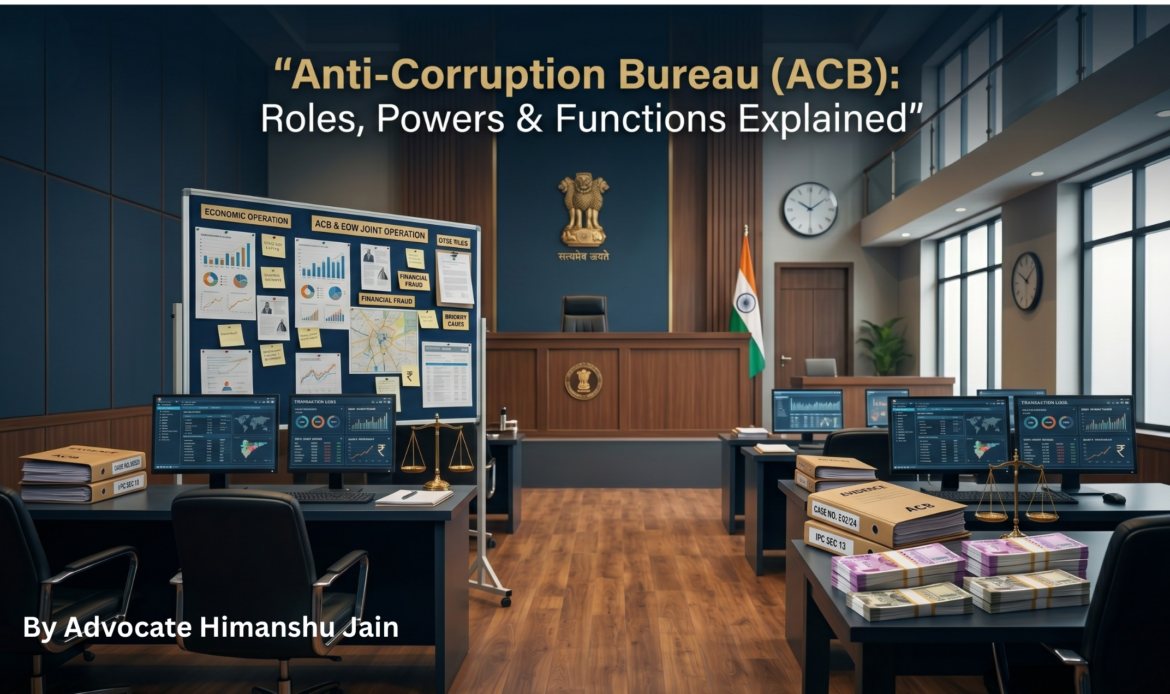
Corruption continues to be one of the most pressing legal and governance challenges in India. Through years of legal practice, it has become evident that institutions like the Anti-Corruption Bureau (ACB) play a decisive role in maintaining accountability within public systems. Working closely with investigative bodies such as the economic offences wing, the ACB ensures that misuse of authority and financial misconduct are brought under judicial scrutiny.
Table of Contents
Understanding ACB and the Role of EOW
The Anti-Corruption Bureau primarily investigates offences involving bribery, abuse of official position, and disproportionate assets. Alongside this, the eow—whose eow full form is Economic Offences Wing—handles intricate financial crimes including fraud, forgery, and corporate irregularities.
Clients often approach with queries like what is eow or how the eow department functions within eow india. In cities like Delhi, the economic offences wing delhi actively investigates high-profile eow cases, and individuals can formally register an eow complaint in matters involving financial fraud or corruption-linked offences.
Roles and Powers of the Anti-Corruption Bureau
From a legal standpoint, the ACB is empowered to:
- Conduct trap operations to catch offenders in bribery cases
- Investigate complaints under the Prevention of Corruption Act
- Collaborate with agencies like the economic offences wing for financial crime investigations
- File charge sheets and support prosecution in court proceedings
These powers are exercised with procedural precision, ensuring that investigations meet the evidentiary standards required in court.
FIR in Corruption Cases & Legal Remedies
In most corruption-related matters, proceedings begin with the registration of an FIR. However, not every FIR is legally sustainable. This is where the concept of quashing of fir becomes crucial.
Many clients seek clarity on what is quashing of fir, especially in cases where allegations are exaggerated or legally untenable. Under the Bharatiya Nagarik Suraksha Sanhita, provisions such as section 528 bnss (also referred to as 528 bnss, sec 528 bnss, or bnss 528 section) grant the judiciary significant authority.
The inherent powers of high court under bnss enable the court to intervene and prevent abuse of legal process. Through an application under section 528 bnss, an accused can request quashing of fir under bnss.
Quashing of FIR: Legal Process Explained
Understanding how to quash fir in high court requires strategic legal planning. The fir quashing procedure involves filing a petition supported by legal grounds and precedents. Courts typically examine valid grounds for quashing of fir, such as:
- Absence of prima facie evidence
- Malicious or false allegations
- Settlement between parties
If the court is satisfied, it may order quashing of fir in high court, effectively nullifying the case. The fir quashed meaning implies that the accused is discharged from further legal proceedings related to that FIR.
Importance of Expert Legal Representation
Handling matters involving ACB or EOW requires in-depth legal expertise. Whether it is responding to an investigation or seeking relief through quashing, professional guidance is indispensable.
Engaging an experienced eow lawyer in delhi, criminal lawyer in delhi, or cyber crime lawyer in delhi ensures that your case is handled with precision. For complex digital or financial offences, consulting the best cyber crime lawyer in delhi or a seasoned advocate in delhi can make a substantial difference.
At Advocate Himanshu Jain & Co., every case is approached with a strategic, detail-oriented mindset, ensuring clients receive comprehensive legal support. Choosing the right lawyer in delhi is not just about representation—it is about safeguarding your legal rights.
Conclusion
The Anti-Corruption Bureau remains a cornerstone in India’s fight against corruption. Working in coordination with the economic offences wing, it ensures that unlawful practices are investigated and prosecuted effectively. At the same time, legal provisions like section 528 of bnss provide essential safeguards against misuse of the law, reinforcing the principles of fairness and justice.