

Published on advocatehimanshujain.com | Criminal Law | Family Law | May 2025
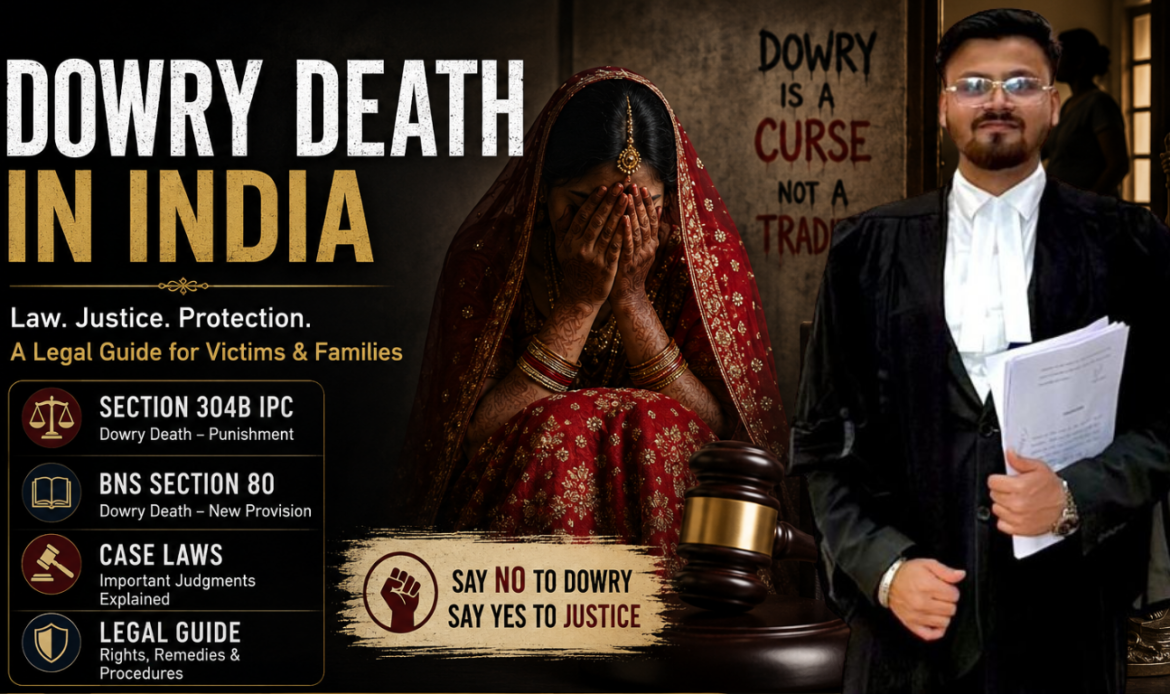
Every few hours, a woman, because of her husband’s family was not satisfied with what she brought to the marriage faces dowry death in India. The National Crime Records Bureau reported over 6,450 dowry deaths in 2022 alone. That is roughly 17 women every single day.
These are not accidents. They are crimes. And yet, many families — both victims’ and accused — walk into these situations without understanding what the law actually says, what investigators look for, and what courts have consistently held.
This article breaks it all down: the law under both the old Indian Penal Code and the new Bharatiya Nyaya Sanhita, the evidence standard courts apply, real case outcomes, and what you should — and absolutely should not — do if you find yourself caught in these circumstances.
Table of Contents
What Is Dowry Death in India? The Legal Definition
Before going into the sections, let’s be clear about what dowry itself means under law. The Dowry Prohibition Act, 1961 defines dowry as any property or valuable security given or agreed to be given, directly or indirectly, by one party to a marriage to the other — in connection with the marriage.
Gifts given out of love, without any condition attached, generally fall outside this definition. But ‘gifts’ that were effectively demanded — even if dressed up as voluntary — do not.
Dowry death, in legal terms, occurs when a woman dies within seven years of marriage under circumstances that suggest burns, bodily injury, or otherwise unnatural causes, and there is evidence that she was subjected to cruelty or harassment in connection with dowry demands before her death.
The Law: IPC Section 304B and BNS Section 80
Under the Indian Penal Code — Section 304B IPC
Section 304B IPC was inserted in 1986 specifically to address the epidemic of young married women dying in suspicious circumstances. To read the full text of the provision, see the Indian Kanoon entry for Section 304B IPC.
| Section 304B IPC — The Statutory Text Where the death of a woman is caused by any burns or bodily injury or occurs otherwise than under normal circumstances within seven years of marriage, and it is shown that soon before her death she was subjected to cruelty or harassment by her husband or any relative of her husband for, or in connection with, any demand for dowry, such death shall be called ‘dowry death’ and such husband or relative shall be deemed to have caused her death. Punishment: Minimum 7 years imprisonment, extendable to life. |
Under the Bharatiya Nyaya Sanhita (2023) — Section 80 BNS
The BNS replaced the IPC with effect from July 1, 2024. Section 80 BNS replicates the substance of Section 304B IPC with the same essential ingredients and the same punishment range. Cases registered before July 1, 2024 continue under the IPC. All new cases use the BNS.
| Provision (IPC) | Equivalent Provision (BNS) |
| Section 304B — Dowry Death | Section 80 — Dowry Death |
| Section 498A — Cruelty to wife | Section 85 — Cruelty to wife |
| Section 306 — Abetment of Suicide | Section 108 — Abetment of Suicide |
| Section 302 — Murder | Section 103 — Murder |
| Section 113B Evidence Act (Presumption) | Section 118 BSA (Presumption) |
The Essential Ingredients Courts Look For
For a conviction under Section 304B IPC / Section 80 BNS, the prosecution must prove four things:
1. Death Within Seven Years of Marriage
The clock starts from the date of marriage, not the date dowry demands began. If the death occurs even one day after seven years, Section 304B does not apply — though other provisions may. For a deeper understanding of how courts have interpreted this threshold, see our related article on Section 498A and marital cruelty.
2. Death by Burns, Bodily Injury, or Otherwise Unnatural Circumstances
Natural deaths from illness, unless connected to dowry cruelty, do not qualify. Courts have accepted poisoning, strangulation, hanging, and forced falls as ‘unnatural circumstances.’ The Supreme Court of India has repeatedly held that forensic evidence on the nature of death is critical.
3. Cruelty or Harassment in Connection with Dowry Demands
This is where most contested cases are fought. The harassment must be linked to dowry — not to other marital disputes. Courts have held consistently that general marital unhappiness does not qualify. For cases involving domestic violence alongside dowry harassment, the Protection of Women from Domestic Violence Act, 2005 provides parallel civil remedies.
4. The Harassment Must Be ‘Soon Before Her Death’
This phrase has been interpreted differently by different High Courts. The Supreme Court settled in Kans Raj v. State of Punjab (2000) that ‘soon before’ does not mean immediately before — it means within a reasonable time, judged case by case. Gaps of weeks or even a couple of months have been accepted where the pattern of harassment was continuous.
The Presumption Clause: Why This Changes Everything
Section 304B contains a built-in legal presumption under Section 113B of the Indian Evidence Act (now Section 118 of the Bharatiya Sakshya Adhiniyam, 2023):
| The Mandatory Presumption Once the prosecution establishes that the death was unnatural and occurred within seven years of marriage, and that there was harassment connected to dowry, the court presumes that the husband or his relatives caused the death. This reverses the usual burden of proof. The accused cannot simply wait for the prosecution to fail — they must actively rebut the presumption with concrete evidence. |
In Baijnath v. State of Madhya Pradesh (2017), the Supreme Court reiterated that this is a mandatory presumption — once the foundational facts are proved, the court has no discretion but to presume guilt. Silence or a mere denial is not a defence.
Section 498A IPC / Section 85 BNS: The Cruelty Provision
Section 304B rarely operates alone. It is almost always read with Section 498A IPC (now Section 85 BNS), which deals with cruelty to married women by husbands and their relatives. For a detailed breakdown of how 498A is used in practice, visit our article on domestic cruelty and the law on this site.
| Category | What It Covers |
| Category (a) — Physical/Mental Harm | Wilful conduct likely to drive a woman to suicide or cause grave injury or danger to her life, limb, or mental health. |
| Category (b) — Dowry Coercion | Harassment to coerce her or her relatives to meet any unlawful demand for property or valuable security, or on account of failure to meet such a demand. |
| Punishment | Up to 3 years imprisonment and fine. |
| Nature of Offence | Cognizable and non-bailable. Police can arrest without a warrant. |
Section 306 IPC / Section 108 BNS: Abetment of Suicide
Where a woman takes her own life due to mental pressure of dowry harassment, the husband and his relatives may be charged with abetment of suicide under Section 306 IPC (Section 108 BNS). This requires evidence of instigation, conspiracy, or intentional aid. Courts have held that continuous harassment pushing a woman to suicide can amount to abetment, even without a direct instruction to die.
The Dowry Prohibition Act, 1961: Often Overlooked
While IPC/BNS provisions deal with death and cruelty, the Dowry Prohibition Act, 1961 directly targets the transaction itself:
| Section | Provision & Punishment |
| Section 3 — Giving/Taking Dowry | Minimum 5 years imprisonment and a fine of Rs. 15,000 or the value of the dowry, whichever is higher. |
| Section 4 — Demanding Dowry | Minimum 6 months, extendable to 2 years, with fine. |
| Section 6 — Dowry for Wife’s Benefit | Any dowry received must be transferred to the wife within 3 months of marriage. |
Real Case Studies: What Courts Have Actually Decided
The following cases represent settled law in India on dowry death. Each link goes to the full judgment text for reference.
Case Study 1: Shanti v. State of Haryana (1991)
| Court: Supreme Court of India Facts: A young woman died of burn injuries within two years of marriage. The defence argued it was a kitchen accident. The prosecution produced evidence of repeated complaints made by the deceased to her parents about dowry demands for a scooter and cash. Held: Conviction under Section 304B upheld. Neighbours’ testimony about quarrels over dowry, combined with timing of death, was sufficient. Direct evidence is rarely available in dowry death cases — circumstantial evidence must be read holistically. Key Takeaway: Neighbours’ accounts, parental testimony, and call records all count. There is no requirement of a dying declaration. |
Case Study 2: Kans Raj v. State of Punjab (2000)
| Court: Supreme Court of India Facts: The deceased had complained to her parents about harassment approximately two months before her death. The trial court acquitted the accused on the ground that this gap was too long. Held: Conviction restored by Supreme Court. ‘Soon before’ must be interpreted based on the facts and circumstances of each case. A continuing course of conduct does not require fresh harassment immediately before death. Key Takeaway: The prosecution does not need to prove harassment in the days immediately before death. A pattern of ongoing cruelty is enough. |
Case Study 3: Satvir Singh v. State of Punjab (2001)
| Court: Supreme Court of India Facts: A woman was found dead of burns. The prosecution relied on a dying declaration made to the woman’s brother — not a magistrate. Held: A dying declaration need not be recorded by a magistrate to be admissible. Even an oral dying declaration to a relative, if voluntary and coherent, carries evidentiary weight — but must be corroborated. Key Takeaway: Dying declarations matter enormously. If a woman is alive when found, getting a statement recorded promptly and properly is critical. |
Case Study 4: Rajbir Singh v. State of Haryana (2010)
| Court: Supreme Court of India Facts: The court found that acquittals under 304B were sometimes being used to escape conviction for murder itself. Held: Trial courts directed to add Section 302 IPC (murder) charges to all dowry death cases, in addition to Section 304B. Key Takeaway: Accused in dowry death cases may face both Section 304B (dowry death) and Section 302 (murder) charges simultaneously. |
Case Study 5: Baijnath v. State of Madhya Pradesh (2017)
| Court: Supreme Court of India Held: The presumption under Section 113B of the Evidence Act is a ‘mandatory presumption’ — once the foundational facts are proved, the court has no discretion but to presume guilt. Key Takeaway: Silence or a mere denial is not a defence in Section 304B cases. The accused must actively rebut with concrete evidence. |
A Note on Misuse: The Arnesh Kumar Guidelines
The Supreme Court in Arnesh Kumar v. State of Bihar (2014) issued strict guidelines: arrest under Section 498A should not be automatic. Magistrates must apply their mind before authorising detention. Police must follow a checklist before arresting.
This was not meant to water down protection for genuine victims. It was to prevent the law from being weaponised against entire families — including distant relatives — on the basis of exaggerated or false complaints. If you are wrongly accused, anticipatory bail is available. Engage a lawyer who knows this area of law.
Do’s and Don’ts: A Practical Guide
For the Family of the Deceased Woman
| DO | DON’T |
| File a complaint with the police immediately. Do not wait or negotiate privately.Preserve all evidence — WhatsApp messages, letters, call records, and photos of injuries.Get copies of any medical reports from earlier visits where she sought treatment.If she is alive but injured, ensure a statement is recorded — by a magistrate if possible.Approach the National Commission for Women or State Women’s Commission if police are unresponsive.Engage a criminal lawyer immediately. | Do not accept any out-of-court settlement without understanding its legal implications. Settling the complaint does not end criminal proceedings.Do not let the in-laws take custody of the body without an FIR and inquest.Do not assume that because the death looks like suicide, there is no case. Section 306 abetment of suicide is a separate serious offence.Do not delay reporting out of social pressure or family embarrassment. Every hour lost is evidence lost. |
For the Accused (Husband and His Family)
| DO | DON’T |
| Engage a criminal lawyer before giving any statement to the police.Collect all evidence showing the death was not linked to dowry: medical records, witnesses, correspondence.Respond to the presumption under Section 113B actively and with evidence.Cooperate with the investigation. Non-cooperation raises adverse inferences. | Do not settle with the woman’s family through cash while a criminal case is pending. Courts view this as circumstantial evidence of guilt.Do not destroy or tamper with any material — phones, clothing, household items.Do not presume the seven-year limit protects you. Section 498A applies regardless of when the woman dies.Do not ignore bail conditions if granted. Violations lead to cancellation. |
For the Woman at Risk
| If you are being harassed for dowry and fear for your safety: Tell a trusted family member. Keep them informed of every incident.Keep a written or digital record of incidents — dates, what was said, by whom.You can approach the police directly under Section 498A without waiting for your parents.Contact a women’s helpline: NCW Helpline: 7827170170 | iCall: 9152987821Speak to a lawyer about a protection order under the Domestic Violence Act, 2005.Do not assume the situation will improve on its own if demands are escalating. |
What the Data Tells Us
| Metric | Figure |
| Dowry deaths recorded (2022) | 6,450 |
| Average per day | ~17 women |
| States with highest numbers | UP, Bihar, Madhya Pradesh |
| National conviction rate | ~34% |
| Source | NCRB Crime in India 2022 Report |
The gap between reported cases and convictions is not a gap in law. It is a gap in enforcement and evidence preservation. The full report is available at the NCRB official website.
The Protection of Women from Domestic Violence Act, 2005
Dowry harassment rarely happens in isolation. The DV Act, 2005 allows a woman to seek civil remedies that run parallel to — not instead of — criminal complaints:
- Protection orders stopping the husband and his family from contacting or harming her
- Residence orders ensuring she is not thrown out of the shared household
- Monetary relief for medical expenses, maintenance, and loss of earnings
- Custody orders for children
Conclusion
Dowry death is not a domestic matter. It is a crime. The law under both the IPC and the BNS treats it as one of the most serious offences in the penal code, with a presumption of guilt built in once the prosecution establishes the basics.
Families who lose a daughter to dowry violence have real legal remedies — but only if they act quickly and preserve evidence. Families falsely accused have genuine defences — but only if they engage experienced legal counsel and respond to the presumption actively.
The single biggest mistake both sides make is delay. In dowry death cases, the first 24 to 48 hours after the incident determine the trajectory of everything that follows.
| Get Legal Help If you need legal guidance on dowry harassment, cruelty under Section 498A, or dowry death cases, contact Advocate Himanshu Jain for a confidential consultation. advocatehimanshujain.com |
Frequently Asked Questions: Dowry Death in India
Q1. What is dowry death in India, and how does the law define it?
Dowry death in India refers to the death of a woman within seven years of marriage caused by burns, bodily injury, or other unnatural circumstances, where it is shown she was subjected to cruelty or harassment connected to dowry demands before she died. Section 304B IPC (now Section 80 BNS) defines it precisely this way and prescribes a minimum punishment of seven years, extendable to life imprisonment. The law was inserted in 1986 after a sharp rise in suspicious deaths of young married women that courts and families had no specific provision to address.
Q2. What is Section 304B IPC, and does it still apply after the BNS came into force?
Section 304B IPC was the primary provision dealing with dowry death under the Indian Penal Code. From July 1, 2024, the Bharatiya Nyaya Sanhita replaced the IPC, and BNS Section 80 dowry death provision now governs all new cases. The language and punishment are identical — minimum seven years to life imprisonment. Cases registered before July 1, 2024 continue under Section 304B IPC. Cases registered after that date are filed under BNS Section 80. If you are dealing with a case registered in the last couple of years, confirm with your lawyer which statute applies, because the procedural rules may differ slightly.
Q3. What is BNS Section 80, and how is it different from Section 304B IPC?
BNS Section 80 dowry death is the direct successor to Section 304B IPC under the Bharatiya Nyaya Sanhita, 2023. There is no substantive difference in the definition or punishment — both require proof that the death was unnatural, occurred within seven years of marriage, and was preceded by dowry-related cruelty. The practical difference is the statute under which the FIR is registered and the court proceedings are conducted. Lawyers, investigating officers, and courts handling post-July 2024 cases will cite BNS Section 80; older case citations will continue to reference Section 304B IPC.
Q4. What is Section 498A IPC cruelty, and how is it connected to dowry death cases?
Section 498A IPC cruelty covers two categories: wilful conduct that is likely to drive a woman to suicide or cause grave injury to her life or health, and harassment to coerce her or her family to meet unlawful demands for property or money. Under the BNS, this is now Section 85. Section 498A almost always accompanies a Section 304B charge — because if a woman died after sustained harassment, the same conduct that constitutes the cruelty before death is prosecuted under 498A, while the death itself is prosecuted under 304B. Section 498A is cognizable and non-bailable, meaning police can arrest without a warrant. The Supreme Court’s Arnesh Kumar guidelines (2014) require police to apply a checklist before making arrests under this section to prevent misuse.
Q5. What are the most important dowry death case laws in India I should know about?
Several Supreme Court decisions form the backbone of how courts handle dowry death case laws in India:
- Kans Raj v. State of Punjab (2000) settled that “soon before her death” does not mean immediately before — a continuous pattern of harassment over weeks or months qualifies.
- Shanti v. State of Haryana (1991) established that circumstantial evidence — neighbours’ testimony, parental accounts, prior complaints — is sufficient for conviction. A dying declaration is not mandatory.
- Satvir Singh v. State of Punjab (2001) confirmed that a dying declaration made to a relative (not just a magistrate) is admissible if it is voluntary and coherent, though it should be corroborated.
- Rajbir Singh v. State of Haryana (2010) directed trial courts to also charge accused with Section 302 IPC (murder) alongside Section 304B, to prevent technical acquittals.
- Baijnath v. State of Madhya Pradesh (2017) reiterated that the presumption under Section 113B of the Evidence Act is mandatory — the accused must actively rebut it, not simply deny guilt.
These five cases are the ones most commonly cited in trial courts across India when dowry death charges are framed.
Q6. What is the punishment for dowry death India?
The punishment for dowry death India under Section 304B IPC and BNS Section 80 is a minimum of seven years rigorous imprisonment, which may extend to life imprisonment. There is no provision for a lesser sentence — seven years is the floor, not a starting point for negotiation. In cases where the court also convicts under Section 302 IPC (murder), the punishment can be life imprisonment or death. Additionally, if the accused is also convicted under Section 498A IPC for cruelty, that carries up to three years imprisonment and fine, running concurrently or consecutively depending on the court’s order. Fines under the Dowry Prohibition Act, 1961 may also be imposed separately.
Q7. What should I do immediately if I suspect my daughter’s death was a dowry death?
The first 48 hours are the most critical. Here is what to do in a dowry death case:
- First, go to the nearest police station and file an FIR under Section 304B IPC (or BNS Section 80 for cases after July 2024) and Section 498A. Do not let the in-laws or police classify it as an accidental death without an investigation.
- Second, ensure a proper inquest and post-mortem are conducted by at least two government doctors. Request copies of all medical reports.
- Third, preserve every piece of evidence you have — WhatsApp messages, letters the deceased sent home, call records, photographs of injuries from earlier incidents, and records of dowry items given.
- Fourth, if she was alive when found and made any statement — however brief — ensure it was recorded. Even an oral statement to a family member can serve as a dying declaration in court.
- Fifth, contact a criminal lawyer immediately. Evidence degrades fast. Witnesses become harder to reach. Every hour without legal guidance is a risk.
If police are unresponsive, you can approach the Sessions Judge, the State Women’s Commission, or the National Commission for Women.
Q8. What is the Dowry Prohibition Act, 1961, and how does it relate to dowry death cases?
The Dowry Prohibition Act, 1961 is the statute that directly prohibits giving and taking dowry. Section 3 punishes the giving or taking of dowry with a minimum of five years imprisonment and a fine of Rs. 15,000 or the value of the dowry, whichever is higher. Section 4 punishes demanding dowry with imprisonment of six months to two years. Section 6 requires that any dowry received be transferred to the wife within three months of the marriage.
In dowry death investigations, the Dowry Prohibition Act, 1961 is used to establish the underlying transaction — that demands were made, that transfers happened under coercion, and that there was a pattern of pressure. On its own it is rarely the lead charge, but it strengthens the prosecution’s case under Section 304B by showing that the marriage was transactional and that the harassment was demand-driven rather than a general marital dispute.
Q9. What is abetment of suicide under Section 306 IPC, and when does it apply in dowry cases?
Abetment of suicide under Section 306 IPC (Section 108 BNS) applies when a woman takes her own life as a result of dowry harassment, rather than being directly killed. The charge requires proof of instigation, conspiracy, or intentional aid. Courts have consistently held that continuous mental and physical cruelty linked to dowry demands — even without a direct statement like “go and die” — can constitute abetment if the cumulative effect was to push the woman toward suicide.
The distinction from Section 304B is factual: if the death appears to be self-inflicted, the charge is likely Section 306 rather than 304B. If the death appears to have been caused by the accused directly (burning, poisoning, strangulation), Section 304B or Section 302 applies. In practice, prosecutors sometimes charge both and let the court determine which is made out on evidence. Section 306 carries a maximum of ten years imprisonment and fine — less than Section 304B’s minimum of seven years, so the distinction matters significantly for sentencing.
Q10. How do I find the right dowry death lawyer in Delhi for my case?
If you are looking for a dowry death lawyer in Delhi, the most important factors are experience in Sessions Court criminal trials (where Section 304B cases are heard), familiarity with the current BNS provisions and how they differ procedurally from the IPC, and a track record in evidence-heavy matters involving forensic reports and dying declarations.
Dowry death cases are not general criminal matters — they involve a statutory presumption of guilt that requires active rebuttal, specific timelines, and often parallel proceedings under the DV Act. A lawyer who handles mostly civil or property disputes is not the right choice here, regardless of seniority.
For families in Delhi, Advocate Himanshu Jain, a dowry death lawyer in Delhi handles criminal matters including dowry death, Section 498A, and domestic violence cases. A confidential consultation can help you understand where your case stands and what steps to take next. Visit advocatehimanshujain.com to get in touch.
Q11. If I am wrongly accused in a dowry death case, what can I do?
Being accused under Section 304B is serious, but wrongful accusations do happen. The Supreme Court in Arnesh Kumar v. State of Bihar (2014) specifically acknowledged the misuse of Section 498A IPC cruelty provisions and issued guidelines requiring police to follow a checklist before arresting anyone. These guidelines apply to 498A arrests and, by extension, inform how courts view arrests in related dowry matters.
If you are falsely accused: engage a criminal lawyer before giving any statement to police. Apply for anticipatory bail immediately — do not wait for an arrest. Challenge a malicious FIR through the High Court under Section 528 BNSS (formerly Section 482 CrPC) if there is clear evidence of false implication. Gather evidence that demonstrates the actual state of the marriage — correspondence, financial records, witness statements, and any prior complaints that show a pattern of targeting your family.
The presumption under Section 113B of the Evidence Act works against the accused once the prosecution establishes the foundational facts — so your defence needs to be proactive and evidence-based, not reactive. Any criminal lawyer in Delhi handling dowry cases will tell you that silence is the worst strategy in a Section 304B matter.